Excerpt: Christmas Day football, a long-standing English festive tradition, came to an end in 1965. This article explores its evolution from a communal ritual to a decline, marking the 60th anniversary of the final fixture.
From Communal Ritual to Mass Appeal: The Rise of Christmas Day Football
After opening presents and finishing Christmas dinner, what’s next? For decades in England, heading out to watch a football match was a viable option—until 1965, when Blackpool and Blackburn Rovers played the final Football League game on December 25. This marked the end of Christmas Day football, a tradition dating back to the 1889-90 season, when Christmas Day became a staple on the football calendar. As one of the few public holidays, it drew large crowds, aided by operational public transport that made attending Christmas Day football convenient for fans.
“Christmas football was originally rooted in a wider tradition of communal entertainments,” noted Swansea University’s Professor Martin Johnes. Unlike the middle-class focus on home celebrations, workers in cramped housing valued getting out. Football, alongside pantomimes and community rituals, offered socialization and joy on their day off. Preston North End pioneered the tradition in 1889, with reigning champion Nick Ross scoring a hat-trick in a 3-2 win over Aston Villa as they retained the title.
Teams typically played return fixtures on Boxing Day to balance travel distances—a practice Blackpool and Blackburn followed in their previous two Christmas Day meetings. Christmas football grew in popularity until 1957, the last year of a full festive fixture list featuring Christmas Day football. The interwar period saw Christmas shift toward private home celebrations, with reduced public services, but Christmas Day football persisted as a brief escape for men. By the 1950s, however, more comfortable homes, slum clearances, and home entertainment like TV made escaping family less appealing, coinciding with falling attendances at Christmas Day football matches.
The Final Whistle for Christmas Day Football: Demise Factors and the Historic 1965 Clash
Floodlights’ adoption by Football League clubs also reduced the need to pack fixtures into the festive period, further undermining Christmas Day football. The 1959 Christmas Day games—Coventry’s 5-3 win over Wrexham in Division Three and Blackburn’s 1-0 victory over Blackpool in Division One—were the last Christmas Day football matches until their 1965 rematch. Professor Johnes emphasized transport as the “real killer” for Christmas Day football: reduced Christmas travel demand and transport workers’ desire for a day off curtailed rail and bus services, making it hard for fans to reach stadiums.

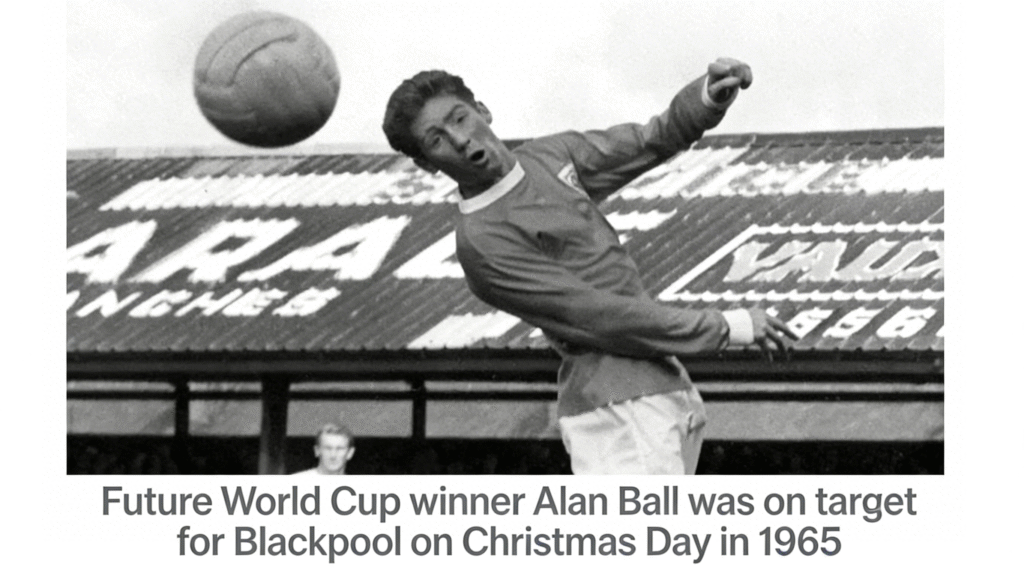
The 1965 clash saw both sides struggling in Division One: Blackburn 20th (just above relegation) and Blackpool 18th. Blackpool had won only once in eight games, while Blackburn had two wins in three. The Tangerines fielded future England World Cup winner Alan Ball, and Blackburn included Wales international Mike England.
A 20,851 crowd watched Neil Turner put Blackpool ahead, with George Jones equalizing before halftime. Blackpool dominated the second half: Bobby Waddell, top scorer Ray Charnley, and Ball scored to make it 4-1. England then netted Blackburn’s second—the final Football League goal on Christmas Day in England. The Boxing Day return was postponed due to a frozen pitch. Blackpool finished 13th, but Rovers were relegated after winning just three of their remaining 20 games. A 1983 Brentford-Wimbledon fixture attempt was moved to Christmas Eve amid fan complaints, cementing Christmas Day football’s end.
Summary: Originating in the 1880s and formally concluding in 1965, Christmas Day football gradually declined due to evolving changing lifestyles and key transportation issues. The pivotal Blackpool-Blackburn match became its historic finale, ultimately bringing an end to this long-standing decades-old tradition.